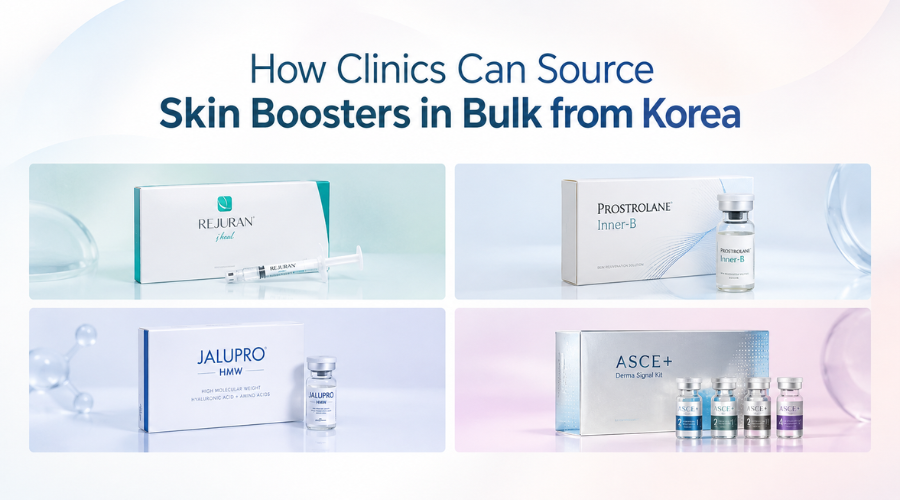
When you buy a skin booster from Korea, first check KFDA approval, hyaluronic acid content, and molecular weight specifications. Korean skin-boosting brands are the global leaders in formulation innovation and pricing. It is a good idea to verify certifications, MOQs, and cold chain handling before committing to the purchase of a bulk order of clinicals.
Korean skin solutions are considered a worldwide benchmark for rehydration and quality skin treatments. Clinics outside Korea increasingly import products directly from Korea to save costs and access newer products. This guide covers supplier evaluation, quality checks, and successful sourcing from a bulk skin booster exporter.
Unlike traditional dermal fillers, skin boosters are made of hyaluronic acid and are injected to increase moisture, elasticity, and skin health. They have lower crosslinking and a micro-sized molecular structure for uniform dispersal in the treatment region. Korean brands such as Rejuran, Juvelook, and IBME lead many Western rivals in skin booster innovation. Additionally, Korean bulk skin booster exporter offer cost-competitive products because their manufacturing base is well established at home, and their R&D-to-market time is shorter than that of many Western pharmaceutical companies.
Certifications confirm that a skin booster manufacturer meets a safety and quality standard recognized worldwide. No certification spells customs clearance problems or liability risk for your clinic. Look for these when you're making your bulk order.
· Clearance by the Korea Food and Drug Administration (KFDA) for domestic markets
· The CE marking is used for products sold in the EU market.
· Medical device quality management system registration to the ISO 13485 standard
· Production standards certified according to GMP (Good Manufacturing Practice)
· Free Sale certification verifying the product is legally sold in Korea.
Certifications are usually valid for 1-3 years. Do not place bulk orders without checking for the current certificate and asking for an expiration date.
The efficacy of a skin booster after injection is determined by hyaluronic acid concentration and molecular weight. Standard skin enhancers contain an HA concentration of 15-30 mg/mL, in contrast to volumizing HA fillers, which often have an HA concentration much greater than 20 mg/mL and a higher crosslinking density. Molecular weight relates to hydration depth and diffusion in tissue. Small-molecular-weight HA (less than one million Daltons) has a more even distribution and less stability. Ask your supplier to provide 100% accurate molecular weight and crosslinking percentage for all product lines you intend to inventory.
Ask for a Certificate of Analysis (COA) for each production batch. All HA concentration, molecular weight, endotoxin testing results, and sterility testing results are confirmed on a COA. Batch-to-batch variations can cause inconsistent results and patient safety complaints. If you’re using an injectable product, make sure the manufacturer tests for bacterial endotoxin, as products used in clinical studies must be sterile. Reliable Korean manufacturers test to less than 0.5 EU/mL, per international standards for injectable product safety.
Typical MOQs vary from 50-100 boxes for regular bulk skin boosters, each of which contains 5-10 vials or pre-filled syringes. Normally, the MOQ is increased to 200-500 boxes for custom branding or private label packaging. For new clinic buyers who want to try out a product line and evaluate the results, some manufacturers will accept smaller trial orders, typically 10-20 boxes. As orders get larger, negotiate volume rates or look for price breaks; many suppliers offer volume rates at 100, 500, and 1,000-box minimums.
Standard production and packaging time is between 15 and 25 days for orders below 500 boxes. Custom branding or private label packaging adds 10-20 days for design approval and print setup. Allow extra shipping days for international orders. The typical method for transporting skin booster products is air freight, which delivers them to most overseas locations in 3-7 days, given cold chain requirements. Along with the extended transit time, sea freight for injectable products carries a high risk of cold chain failures.
Skin boosters must be stored cold from manufacturing to delivery, usually at 2-8°C. Even if the packaging seems undamaged when it arrives at the work site, a temperature excursion can degrade the HA structure and reduce the product's effectiveness. Ask the supplier where the temperature is checked throughout the air freight handling process. Good suppliers will provide a complete record, using temperature data loggers fixed to the shipment. Request this documentation with all bulk shipments, not just on demand during a dispute.
All shipments of bulk skin boosters should include appropriate documentation that confirms product authenticity and compliance. Incomplete paperwork may also delay customs clearance or raise issues during a regulatory audit of your clinic's supply chain.
· The Certificate of Analysis (COA) for the batch being shipped.
· The KFDA approval certificate or Certificate of Free Sale.
· Temperature data log recorded by the cold chain monitoring device.
· Commercial invoices and packing lists are required for customs clearance.
· Halal or other market-specific certification as necessary
Ensure these documents are included with all shipments, not just the first order. Some suppliers base full documentation only on initial orders, and repeat orders only come with incomplete documentation.
The price of skin boosters varies by brand, depending on their HA percentage and packaging type. Entry-level Korean skin products range from $15 to $15-$30/vial. Prospective, established brands with known clinical data and market recognition cost $30-$60 per vial. Private label or white label products are labeled and made by a manufacturer but are usually 10-20% more expensive, with higher prices indicated by a higher MOQ. For an accurate price comparison between suppliers, compare quotes that are the same package type and HA level.
Direct manufacturers normally offer better pricing and more flexibility for formulation and packaging customization. Trading firms add a markup to goods, usually a 15-25% increase over the manufacturer's price; however, they simplify communication and may also provide export documents. A trading company saves clinics that purchase less than 100 boxes annually from logistical complexity and communication hassles. If you're a clinic or distributor ordering more than 500 boxes per year, it's normally cheaper and lets you access new product releases before they're available to the rest of the market.
Importation of skin boosters differs greatly between countries, as most are considered medical devices or pharmaceuticals. Check your country's registration requirements before placing a bulk order, as customs may seize unregistered products. Even with KFDA and CE certifications, some countries still need local certification. Coordinate with a regulatory consultant experienced in the regulatory environment of the market where you intend to import medical aesthetics.
If you can order goods consistently, that will foster trust and, at times, better terms. Repeated orders often mean suppliers receive better payment terms, quicker lead times, along with access to new product launches before wider market adoption. Communicate the predicted volume of treatments with your supplier ahead of time. This enables them to schedule production and reduces the chance of stock-outs during peak demand, such as before major holidays or during seasonal peaks.
Generally, skin boosters have a shelf life of 18-24 months after the production date when stored in a proper refrigerator, under proper conditions, and with proper air circulation. Base planned order volume on the pace of treatments booked, not just bulk discounts. Stock that's near expiration can strain a budget and can lead to products being used beyond their potency window, limiting treatment consistency for patients.
Compared with consumer products, medical products undergo more stringent customs inspection. Ensure your customs broker is familiar with medical device and pharmaceutical imports, as general freight forwarders might lack knowledge of the necessary extra paperwork. The shipping team prepares all paperwork before the shipment leaves Korea, such as COAs, KFDA certificates, and import permits. If documents are missing upon arrival in the beneficiary's country, the shipper may be liable for additional storage charges and the cost of arranging the paperwork.
Importing skin boosters from Korea in bulk requires the verification of product formulations, certifications, and the reliability of the cold chain before investing. Compare MOQs and lead times with your clinic's treatment volume. Complete paperwork for all shipments and verify the destination country's import regulations. These steps will help you build a reliable supply chain so your clinic can deliver uniform, quality skin booster treatments.
What kinds of certificates does a Korean skin booster manufacturer need?
Ask for KFDA and ISO 13485 certification at least!. Also ensure production standards comply with CE marking and GMP certification for EU markets.
What is the lowest bulk quantity of skin boosters available from Korea?
MOQs typically start at 50-100 boxes for standard formulations. Custom or private-label packaging typically increases the MOQ to 200-500 boxes.
What is the delivery period for skin boosters in bulk from Korea?
Standard production takes 15-25 days, plus 3-7 days for air freight shipping, due to cold-chain shipping requirements for injectable products.
What is the significance of cold chain transportation of skin boosters?
Skin boosters must be stored at 2-8°C from production to delivery. Temperature excursions can also affect the HA structure, and product effectiveness can be compromised even without packaging damage.
Highlights When you buy a ski
READ FULLThe injectable hydration market is not slowing down. Not even close.
READ FULLIt is not easy to find a trusted supplier of any product until you s
READ FULL