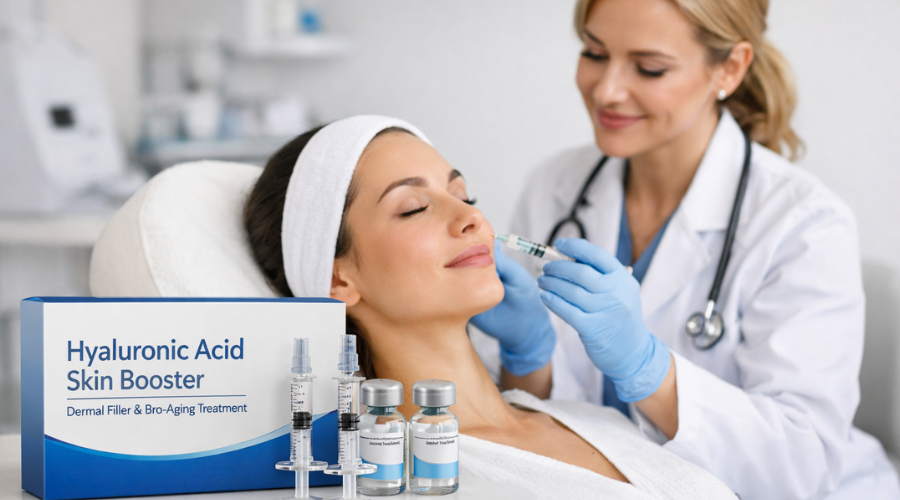
Hyaluronic acid (HA) skin boosters are injectable treatments intended for the enhancement of the overall quality of your skin by improving the hydration of your skin and smoothing out the fine lines created from being dehydrated. They are injected in small amounts throughout multiple areas with a treatment area, as opposed to being used for building up the shape and changing the structure of your face.
Skin boosters are different than dermal fillers. Dermal fillers are mainly used to create volume to your face, such as the cheek area or to add volume to the lips. Skin boosters have an effect by making your skin look and feel better over multiple areas, such as your cheeks, lower face, neck, and hands, without changing how you look.
Hyaluronic acid is a substance your body naturally produces. One of its main roles is binding water, which is why it is associated with hydration and a plumper skin appearance.
When HA is placed into the skin through injections, it can increase water retention in the treated area and improve the look of dryness-related texture. Many patients describe the result as skin that looks more hydrated and reflects light more evenly, rather than looking “filled.”
Injectable HA treatment for skin quality is not a shortcut to lifting, tightening, or correcting deeper folds. If your main concern is sagging or structural volume loss, this treatment will prove ineffective for you.
Skin boosters are the perfect remedy for skin that has a dull appearance and fine lines that make anyone appear aged, particularly if they have dry skin. The booster resolves the dull appearance and dry texture through skin hydration and makes fine lines disappear gradually. They are often chosen when your goal is a healthier-looking surface rather than a visible change in facial shape.
Hyaluronic acid skin boosters are frequently used on the face, and they are also commonly used on the neck, chest (décolletage), and hands. These are areas where dehydration and crepey texture are common and where heavy volumizing treatments may be inappropriate.
You are more likely to find this treatment worthy and fulfilling if your expectations are modest and your approach is to go for a gradual improvement route rather than the fast track transformation. If you want natural-looking results that do not read as “work done,” skin boosters often fit that preference.
Skin boosters are not magical remedies and have their limitations. They cannot replace treatments that change facial movement or alter the facial structure. Moreover, they are not made for the correction of deep wrinkles or for the restoration of volume deficit in the midface. Other skin issues, like sun damage and discolored appearance also do not go away with a skin booster. Instead, they require other specialized treatments.
It is vital to have a clear idea regarding treatment capabilities as many beginners overlook this in favor of cheap price quotes and end up paying double the amount. The first time for the incorrect treatment and the second for the correct treatment.
HA injectable formulations vary and are created to tackle specific issues. Expecting them to give the same results is incorrect. Some injectables are designed to spread smoothly in the skin and improve skin hydration and texture. Others have a thicker consistency and can provide subtle plumping in addition to hydration. Your clinician will choose a product and technique based on your skin thickness, the area being treated, and your risk profile.
Certain skin zones, such as under the eyes, are quite delicate, and even a slight mistake by the practitioner during injection results in a major negative visual outcome. Here, the product selection and depth of placement matter a lot to reduce the risk of visible swelling, or unevenness. For first-time patients, it is usually safer to start conservatively and build gradually.
A proper consultation usually begins with a medical history review and a discussion of concerns and areas that you want to improve. During the consultation, the practitioner will take photos of your skin areas for documentation and planning. Be prepared to answer some qualifying questions as well. These relate to prior injectable treatments, previous reactions, autoimmune conditions, active skin issues, and any history of cold sores if the area is near the mouth.
To reduce bruising risk, many clinics recommend avoiding alcohol and certain supplements or medications that can increase bleeding for a short period before treatment. You should not stop prescribed blood thinners without instructions from your prescribing clinician.
At first, your skin will be cleaned thoroughly, and following that, a suitable numbing solution will be applied to the treatment area. Skin boosters are then administered through multiple small injections or, in some cases, with a cannula technique, depending on the area and the clinician’s preference. During the procedure, a brief stinging, pressure, or scratch-like sensation is experienced. Although the procedure is brief and hassle-free, expect the first session to last longer as more time is taken for assessment and setup.
Right after treatment, it is normal to see small raised bumps at injection sites and mild redness. Over time, this will go away as the product settles and the skin calms.
If you have an important event where you will be meeting many people, it's better to refrain from scheduling the first skin booster appointment just before it.
Some hydration improvement can become apparent nd visible relatively quickly, but the deeper skin quality change is often gradual. Your skin needs time to settle after injections, and your result is usually clearer over the following weeks.
Skin boosters are often performed as a short initial series spaced weeks apart. Then, a series of maintenance sessions is done to confirm the progress of the treatment. This approach is common because skin hydration and quality respond better to planned, cumulative improvement than to one aggressive session.
There is no fixed estimate on how long the treatment effects will last. It varies widely as it depends on a host of factors like the product type, the area treated, your metabolism, and your skincare routine, etc. Maintenance is included in the treatment plan because the success of treatment depends on it. Permanent change with one session is a myth.
Bruising, swelling, and redness, are commonly faced by patients and these effects are temporary and fade. Small lumps or bumpiness can occur at injection sites, particularly early on, and typically improve as swelling resolves.
Infection is possible with any injection. Inflammatory reactions are also a risk that can occur in rare cases. A visible complication that happens is nodules. These may require assessment and treatment, so you should not ignore a change that is getting worse rather than better after the first few days.
A vascular occlusion happens when a product affects a blood vessel. This is uncommon, but it is serious and time-sensitive. Warning signs can include increasing, disproportionate pain; skin blanching or a white, dusky, or mottled discoloration; coolness of the skin; and changes that worsen rather than improve. Vision changes or severe eye pain after facial injections is an emergency.
If you develop these symptoms, treat it as urgent. Contact your injector immediately and seek emergency care if instructed or if you cannot reach them promptly. Do not wait to “see if it settles.”
For risk reduction, your provider choice matters more than the brand of product. The most suitable practitioner is someone who is licensed and specializes in skin treatments. They should follow all the protocols of administering the injection, such as using a sterile technique and having the necessary supplies at hand to manage complications. You should also expect transparent documentation of the product used. That means the specification of the product and information about hyaluronic acid skin boosters exporter from which they source from.
The practitioner will give you aftercare instructions, and they vary from treatment to treatment. Make sure to stick to those instructions. Instructions that are common to every treatment are avoiding heavy exercise and heat exposure (such as saunas and hot yoga). Refraining from drinking alcohol since that increases bleeding risk, and avoiding unnecessary touching of the treated area.
Simple and straightforward routine wins here. That means usage of gentle cleansers and barrier-supportive moisturizer, along with daily sunscreen. Avoid introducing strong active ingredients immediately after treatment if your skin is irritated.
Contacting the clinic should be done only in case of complications like worsened swelling after 48 hours, or spreading of redness, warmth, and pus. More serious side effects include fever, new lumps that are growing, and skin color changes. Early assessment prevents small issues from becoming prolonged problems.
|
HA skin boosters |
Dry, dull skin. Fine dehydration lines. Crepey texture on face, neck, chest, hands. |
Lifting. Big shape changes. Deep wrinkles. True scar resurfacing. |
Mild. Small bumps and redness. Some swelling. Bruises can happen. |
Pros: Looks natural. Improves skin quality without changing your face. Works well as a plan over time. Cons: Often needs a short series. Needs upkeep. Wrong choice if your main issue is sagging or lost volume. |
|
Neuromodulators (“Botox”) |
Lines from movement. Forehead lines. Frown lines. Crow’s feet. |
Dryness. Rough texture. Volume loss. Sun spots. |
Low. Small bumps for hours. Bruising sometimes. |
Pros: Predictable for movement lines. Can prevent lines from getting deeper. Cons: Does not hydrate skin. Can look heavy if overdone or placed poorly. Needs repeat visits. |
|
Dermal fillers |
Volume and shape. Cheeks, lips, jawline. Support in key areas. |
Overall “glow.” Treating dryness alone. Fixing pigment. |
Medium to high. Swelling is common. Bruising is common. |
Pros: Strong change when you need support. Can restore balance fast. Cons: Higher risk than many skin-quality treatments. Can look unnatural if too much or in the wrong place. Costs rise if you use it for the wrong goal. |
|
Energy devices (laser, RF, ultrasound, IPL) |
Tone and texture. Sun damage. Pigment and redness (device-dependent). Some tightening (device-dependent). |
Instant volume. Movement lines. Quick fixes for all concerns. |
Varies. Sometimes none. Sometimes days of redness and peeling. |
Pros: Can treat sun damage that injectables do not. Can improve texture and tone. Cons: Results vary by device and operator. Wrong device wastes time and money. Some options need real downtime. |
|
Microneedling (± PRP) |
Texture. Pores. Mild scars. Gradual skin quality gains. |
Fast results. Lifting. Replacing volume. |
Low to medium. Redness for 1–3 days. |
Pros: Good for texture over a series. Often works well with other treatments. Cons: Needs multiple sessions. Poor hygiene or wrong depth raises risk. Not the same as hydration-focused injectables. |
If you want to create or change the appearance of your facial structure/bones or improve by means of hyaluronic acid skin boosters then these are the perfect choice. Therefore a planned series of injections (along with appropriate periodic/continuous maintenance) may give you some modest improvements.
As similar to other types of injections, hyaluronic acid injections are not going to be an effective way to achieve a lifting effect or to repair deep wrinkles or fill in completely lost volume. The best way to avoid wasted treatments with hyaluronic acid is to ensure that what you are treating is the right area/product, etc., for the type of concern you have.
When you treat hyaluronic acid skin boosters as part of a more organized treatment plan (as opposed to a random treatment), you will increase your chances for producing successful treatment results and decrease your chances of having treatment delays, unexpected costs from the treatments (after they have taken place), and the likelihood of developing preventable complications after your treatments.
People around the world face various skin aging problems after a spe
READ FULLSometimes the skin needs more radiance and elasticity than volume. N
READ FULLHyaluronic acid (HA) skin boosters are injectable treatments intende
READ FULL