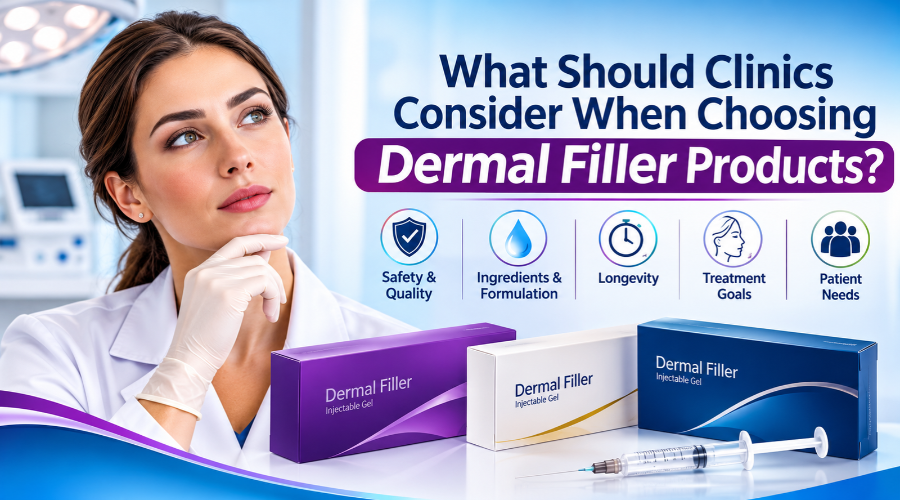
Today, dermal fillers are among the most in-demand treatments in aesthetic medical practices. Patients look for softer lines, restored volume, natural results, and safe results from their practitioners. This leaves a lot of pressure on the clinic owner's choice of fillers to stock. A bad decision can lead to inconsistencies, patient wooing, and real-life danger. The right one builds trust and keeps people coming back.
If you're considering starting a new range or upgrading your current set, here are some factors to consider before ordering a range.
The utmost priority is safety. The correct fillers must be approved for your market, for example, CE marked for Europe, FDA approved for the United States, or other approval by your local health authority. Approvals indicate that the product has been quality tested, sterilized, and proven to be biocompatible.
Don't settle for a promise; ask your supplier for proof. Certification drawings, batch records, and instructions for use should be provided upon request. When a supplier is non-specific about approvals or a drastically low cost, it should be taken as a big red flag. The use of counterfeit and 'grey' fillers in the beauty industry is a recognized issue, and the potential side effects on patients can be serious.
Hyaluronic acid (HA) is the most common filler on the market, as it holds water, creates volume, and can be broken down by hyaluronidase if there is a problem. This is one of the reasons why clinics favor HA over the more lasting options.
Still, not all HA fillers are alike. Variances in cross-linking technology, particle size, and concentration influence the feel, spread, and lasting power of a product. As for Colena dermal fillers, when speaking with different providers, inquire about the details of the gel construction and the products each one claims to treat. A good manufacturer will describe these differences in detail in terms of viscosity, elasticity, and injection depth.
Different parts of the face require different fillers. The fine lines around the eyes and lips require a soft, smooth-appearing gel that blends nicely. For cheeks, jawline, and chin, there need to be sturdier products that will help to provide structure and shape. Typically, a balance between the extremes is best for nasolabial folds and marionette lines.
The wide range allows you to customize the treatment to the individual patient, rather than getting the one product to “do all.” When purchasing wholesale, make sure the line reflects your clinic's major indications to avoid having to deal with multiple suppliers to create a simple menu.
Patients often ask about the expected duration of results, and you need to give them a truthful answer. HA fillers can last anywhere from 6 months to approximately 2 years based on the product and area being filled. These may be more expensive per syringe but can also provide longer-lasting results by reducing the frequency of touch-ups.
Consider your patient's values. Some are looking for occasional but frequent perspectives; others for less frequent schedules. Offering choices with varying durability can give you flexibility, but don't over-promise. Since every person's body is unique due to differences in metabolism, lifestyle, and injection technique, results will differ.
Being consistent is as important as quality. If one batch doesn't perform like the others, your results will become unpredictable quickly, and your confidence will be lost. Use suppliers that produce according to known quality standards like ISO 13485 and exhibit batch traceability.
Look at the packaging too! Syringes should be delivered sealed, labeled, and with the tamper-evident features intact. Lot numbers and expiry dates must be legible and be noted in a patient's file. This keeps you and the patient safe if something ever goes wrong.
All products have potential side effects, such as swelling, bruising, lumps, and, in rare situations, vascular complications. A clinic that's responsible is prepared for this in advance of the first injection. Always keep hyaluronidase on hand, train staff on emergency procedures, and only use products that have been proven safe. See if your supplier can provide clinical studies, practitioners' guidance, and safety reports. A company that backs its products will generally advertise both the good attributes and the bad.
There is, of course, the price factor, particularly if purchasing in bulk. Wholesale purchasing will help you keep the product in stock and will reduce your price per syringe while increasing your margins. However, cost shouldn't be the only determining factor.
When examining wholesale offers, consider all elements of the package, including the minimum purchase quantity, associated price reductions, shipping costs, payment terms, and procedures for returns or damaged product. Another thing to check is whether or not the product has a shelf life or whether the product expires before you're able to use it. Sometimes it costs less to pay a little more for a reliable provider than to deal with the issues from a cheap one.
A good supplier is more than just a seller. Look for one with experience, clear communication, and reliability. Find out how orders are packaged and sent to you for fillers, and confirm their storage and transportation temperatures. It's nice to have training and technical support. Training in product knowledge, injection techniques, and marketing strategies can be provided by some suppliers, helping new users with confidence. A question about a certain batch or a need to resolve a delivery problem is a situation where responsive after-sales service also comes into play.
Speak with other clinics before picking a brand. Inquire from colleagues about their preferred products, effectiveness, and what the supplier does with them if something goes wrong. You can find accurate feedback at professional sites, training classes, and industry events. The patient's satisfaction is also valued. When your patients keep telling you how natural-looking their results are and how the incision has healed, you know that you're on the right track.
There are three gels that address most of the needs: fine lines, mid-face, and firm contour. Use lip-specific or niche lines only when patients request them.
Most fillers now require 0.3% lidocaine to be included in the gel they are mixed with. Patients do not feel during injection, and many clinics forget to put the separate numbing cream in, which saves much of the office time. Read all labels; products without lidocaine are still available. Have a few of those lidocaine-free syringes in stock. Patients with an allergy to amide anesthetics can’t have the standard version. Place it on the intake form, and repeat it at every visit because it gets lost in people's memories.
Request a sample lot and inspect boxes, labels, and lot numbers when received. Scale up order, treat a few consented, at low-risk areas, and review at two and twelve weeks.
Filler is just as good as the hands using it. Each injector requires training in anatomy and complications, and there's no such thing as a product demo. Request specific instructions for use in your native language, technique guides, and a point of contact for any clinical questions. Most benefit from most suppliers running webinars or hands-on workshops, especially when a new grade or treatment area is added to the clinic. Maintain documentation of who was trained on which product. Sometimes, insurers and regulators request it, typically when there is a problem.
Store syringes in a locked, labeled cabinet at the recommended temperature with a thermometer and a daily log. Stock is slowly lost in a car boot sale or sunny windowsill. Put everything by expiry date, with the oldest boxes first. Never reuse a syringe or share one between patients. Discard opened the product at the end of the session. Place needles in a sharps container, and place each lot sticker from the box in the patient's record.
The choice of a dermal filler is ultimately down to proof and fit. Ask for proof of approval, use the right gel for the treatments, verify supplier paperwork, and calculate the cost per treatment. If you've been considering ordering wholesale Colena dermal fillers, check the certificate, grade, fill volume, and local import regulations, and then opt for a sample order first.
Purchase from a reputable exporter or licensed distributor who provides CE paper copies, batch prints, and lot-tracked boxes.
A written quote determines the price. The market price is about $18 per piece, with 100 pieces per listing.
Inquire with manufacturers/exporters about custom boxes and labels, and check whether support is offered for market registration.
Ask for multi-unit discounts for bulk orders and ask for shipping, packing, and delivery dates in a quotation.
Yes. The S, M, and L grades list 0.3% lidocaine.
Today, dermal fillers are among
READ FULLHighlights When you buy a ski
READ FULLThe injectable hydration market is not slowing down. Not even close.
READ FULL